Configure dispatch dates
How lead times and dispatch dates influence each other, and how to modify your estimations
Communication of dispatch dates for part manufacturing is essential. We use a combination of manufacturing durations and lead time buffers to provide your customers with a best-guess estimation of when a part will be ready to be shipped.
Calculating a duration
You can calculate an estimated duration to fulfil a requisition, known as the manufacturing duration, directly within your process and post-process equations.
The dispatch date is then calculated based on the requisition with the longest manufacturing duration, plus the selected lead time buffer duration on top. The formula for dispatch dates is as follows:
date on which quote becomes order + max requisition manufacturing duration (process duration + Σ(post-process durations)) + lead time bufferTo export a duration from your process and post-process equations, you can supply it as an optional second parameter to the done() function, like so:
done(unitPrice, 24)For non Factory Floor plan users, you will need to model your workflow and provide an estimated duration for each process and post-process in order to make this as accurate as possible. In the above example we've just supplied 24 hrs as an arbitrary value.
Here's an example of how we arrive at a dispatch date for a quote with a single requisition in it:
Date of quote becoming order:   15 August
Process duration:               24hrs
Post-processing duration:       48hrs
Selected lead time buffer:      48hrs
---
Manufacturing duration:         5 Days     = (24 hrs + 48hrs) + 48hrs
Estimated dispatch date:        Aug 20th   = Date of quote becoming order + 5 Days
Explicit Dispatch Dates
Everything detailed before is to get you as close as possible to an estimated dispatch date, it is by no means authoritative. When attaching shipping to an order, you can optionally specify a dispatch date, and this will be used instead of the estimated date. This means that you, as the manufacturer, still have total control.

However, do note, that orders which have no shipping, do not have an associated dispatch date, so it's vitally important that you specify shipping whilst an order is still a quote.
Workflow durations
For Factory Floor plan users, we allow you to set a Duration in hours on each operation under Settings > Manufacturing > Operations. Each process and post-process is assigned a set of operations through its workflow, so we're able to calculate the overall expected duration from the assigned operations automatically. This means you can omit the duration entirely in the done() function.
If you wish to override the estimated duration for a process or post-process, you can still supply a secondary parameter to the done() function, and to make life easier, you can also access the estimated workflow duration through workflow.duration in your equations directly.
This gives you the flexibility to modify the estimated duration based on things such as quantity, and geometric properties such as volume and area of parts in a requisition.
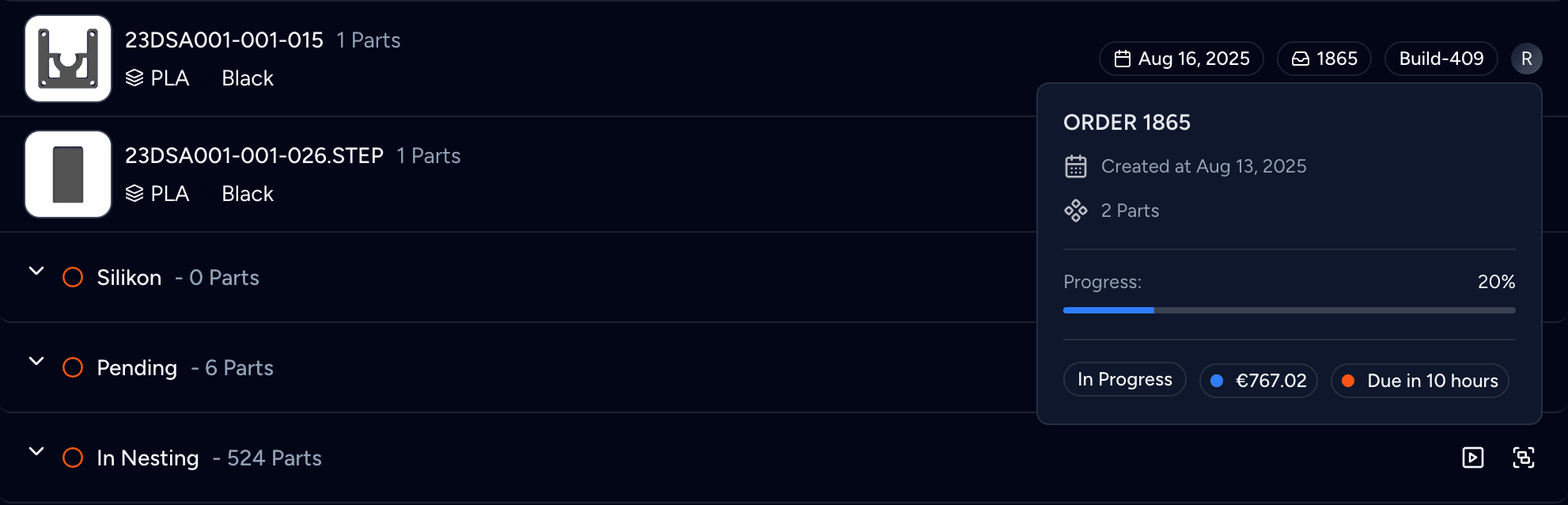
Production > Backlog shows a due date on each group. It is the work order's due date if one is set. Otherwise it is the dispatch date minus the hours of the operations the parts still have to pass through. The backlog sorts the groups at each operation by the work order's due date, or by the dispatch date when no due date is set, so the parts due soonest are at the top.
Last updated on